Back to Blog
Blog
Beyond the Dust: What We’re Learning and How to Help Great Salt Lake

Sitting left to right: Derek Mallia, Bryce Bird, and David Parrott, with Lindsie Smith at the podium during Solution Series: Beyond The Dust.
What are we learning about dust from Great Salt Lake, and what can we do to help?
At Beyond the Dust, part of our Solutions Series, we brought community members together with Bryce Bird of the Utah Division of Air Quality, Derek Mallia of the University of Utah, and David Parrott of Westminster University’s Great Salt Lake Institute to help answer this question. Together, we explored where dust comes from, what researchers are discovering, and the steps that could help protect the lake and surrounding communities.
Understanding the Air Quality Measurements
Air quality reports can feel like a jumble of numbers and abbreviations. Bryce Bird helped explain what those measurements tell us and why understanding exposure matters. “It’s the exposure that really makes the difference,” Bird explained.
Two terms that kept coming up were PM10 and PM2.5. “PM” stands for “particulate matter”: tiny particles and droplets floating in the air. PM10 includes particles 10 micrometers wide or smaller; PM2.5 includes finer particles measuring 2.5 micrometers or less. Both are much smaller than the width of a human hair and small enough to enter our lungs. Federal standards limit how much of this pollution can be in the air.
At the time of the panel, Bird said the Salt Lake Valley had not exceeded the PM10 standard in 2026, while the ozone standard had been exceeded 19 times. Ground-level ozone is a different pollutant, and those exceedances help explain why it remains an immediate regulatory priority.
But measurements below federal limits don’t answer every question about dust. Bird discussed expanding monitoring to collect samples upwind and downwind of the lake. That work will help identify what reaches nearby communities and support health guidance as more information becomes available.
Tracking Where Dust Comes From
Where does the dust begin, and where does it go? Derek Mallia’s research is focused on helping connect those questions.
“We’re trying to build a pie chart,” Mallia said. “We’re trying to figure out where our dust is coming from.” That comparison made the work easy to picture. Dust reaching a community can come from many places: the lake bed, mining operations, construction activity and other dry landscapes. His team is developing computer models to estimate how much each source contributes.
The lake bed itself is also complicated. Some areas have a protective surface crust, while others release dust more easily.
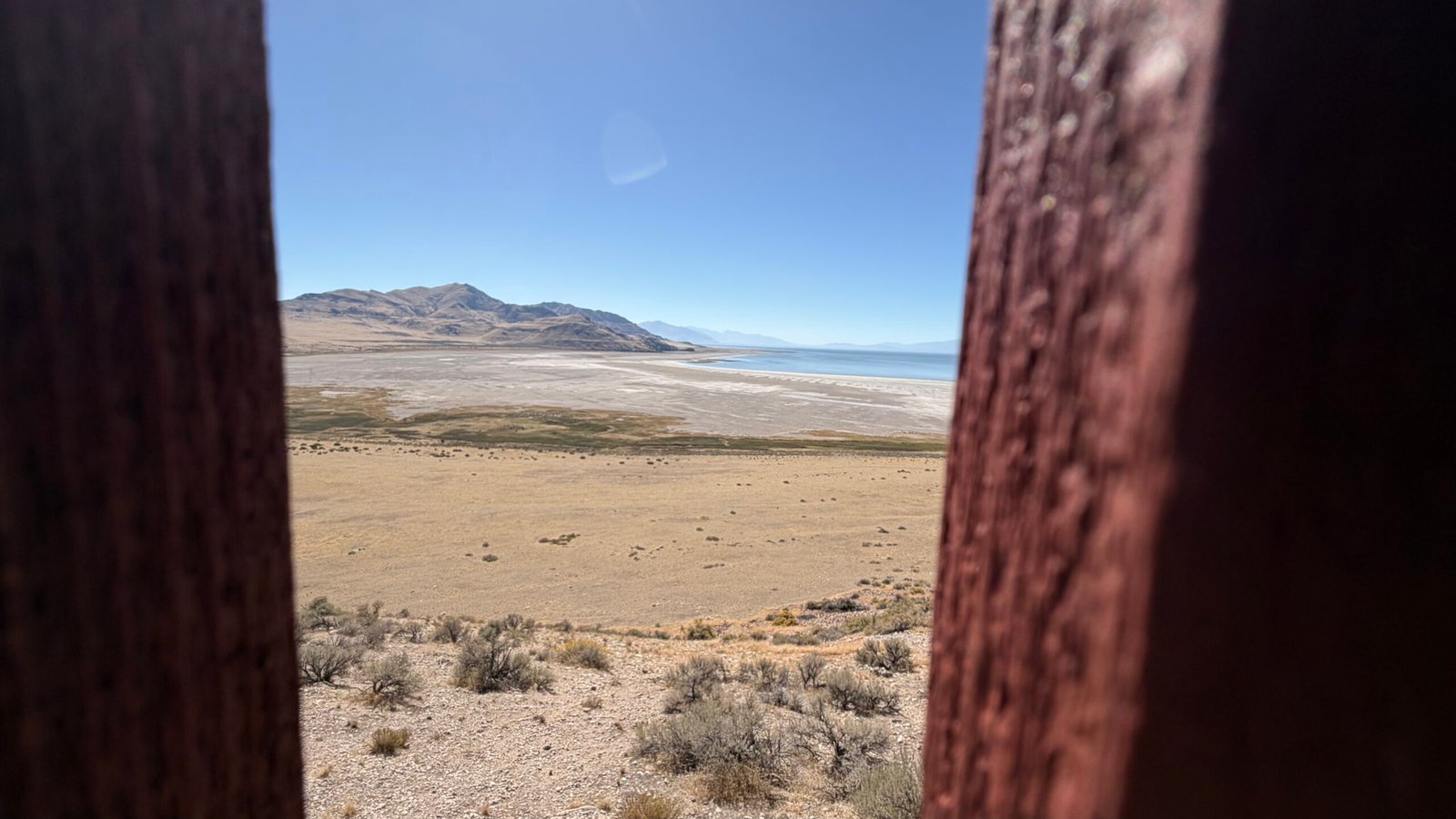
Mallia highlighted Farmington Bay as an important source because of its proximity to surrounding communities.
His team plans to use additional monitoring data to improve its models. Measurements show what is happening at specific locations, while models help fill the gaps between them. Together, they can help identify where dust-control efforts would have the greatest benefit.
What We’re Still Learning
Knowing where dust comes from is one piece of the puzzle. Understanding what travels with it is another.
David Parrott introduced us to the bacteria and fungi that can move with dust. His team compares samples from lakebed hotspots with dust collected on Westminster’s campus, roughly 11 miles away. On windy dust-event days, they’ve observed changes in the types of microbes collected. These are potential clues about where the microbes came from, although other dust sources may also contribute.
The research group is also examining metals and microplastics and studying how collected materials affect human lung cells grown in the lab.
“We’re just starting to scratch the surface of this in our research group,” Parrott shared.
These studies are still developing. Identifying something in dust is a starting point; understanding its source, the amount people encounter and its potential effects requires more work. We appreciated Parrott’s enthusiasm for discovery and his openness about what remains uncertain.
Moving Toward Solutions
Getting more water to Great Salt Lake remained central to the discussion. As Derek Mallia put it, “The cheapest and easiest thing to do would just be to get water back into the lake.”
While work continues toward that goal, panelists discussed ways to reduce dust from exposed areas. These include keeping lakebed surfaces moist and using surface treatments that slow wind at ground level, making it harder for dust to become airborne. Mallia emphasized that different areas may require different approaches, and that engineered controls can carry substantial costs.
Protecting the lakebed’s existing surface crust is another practical step. Bryce Bird explained that restrictions on off-highway vehicles help prevent disturbance of that protective layer, reducing the chance of soil becoming windblown.
Better monitoring and modeling can help identify which hot spots to address first. Together, these tools support a focused approach: protect stable surfaces, target areas producing the most dust, and continue getting water to the lake.
What We’re Learning, and Where We Go From Here
So what are we learning about dust from Great Salt Lake? It’s not one problem. It’s a set of connected questions. Bird’s work shows how exposure is measured and where monitoring needs to grow. Mallia’s models are starting to show which sources contribute the most, and where. Parrott’s lab is looking at what travels with the dust and what that could mean for health. Each piece adds to the picture, and each one shows where the next questions are.
What came through clearly is that there are solutions, and they work best together. Better data shows where to focus. Protecting the lakebed’s surface crust keeps dust on the ground. Targeted controls can address the hot spots that matter most. And getting water to the lake remains the most effective step of all.
What can we do to help?
- Stay informed. Check daily air quality readings through the Utah Division of Air Quality, especially on windy days.
- Respect the lakebed. Following off-highway vehicle restrictions helps protect the crust that keeps dust in place.
- Support water for the lake. Saving water at home and at work, and backing policies that deliver water to Great Salt Lake, adds up.
- Keep the conversation going. Join us at an upcoming Solutions Series event, where researchers, policymakers and community members work through these questions together.
The research is still developing, but the path forward is getting clearer. Each conversation like Beyond the Dust brings us closer to solutions that protect the lake and the communities around it.
Related Articles