Back to Blog
Blog

Behind the Scenes at Utah State University’s Water Research Laboratory
Water research plays an important role in addressing some of Utah’s biggest environmental challenges, especially those facing the Great Salt Lake. Recently, we had the opportunity to tour the Utah Water Research Laboratory (UWRL) at Utah State University and see firsthand how researchers are working to better understand water.
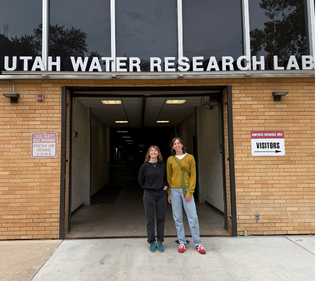
Our visit was coordinated by Marian Rice and led by Beth Neilson, who walked us through the facility, shared insights into ongoing projects, and helped us see how this research connects to real-world water management.
Seeing Water Research in Action
We started in the hydraulics laboratory, where researchers use scaled models to study how water moves through dams and other infrastructures.
One of the most interesting stops was a dam model designed to study how structures can dissipate the energy and force of moving water. Beth explained how researchers use these models to understand erosion, downstream impacts, and ways to improve infrastructure design.
I was fascinated by the level of detail involved. Researchers use LiDAR data to recreate terrain and build physical models that allow them to observe water behavior under controlled conditions.
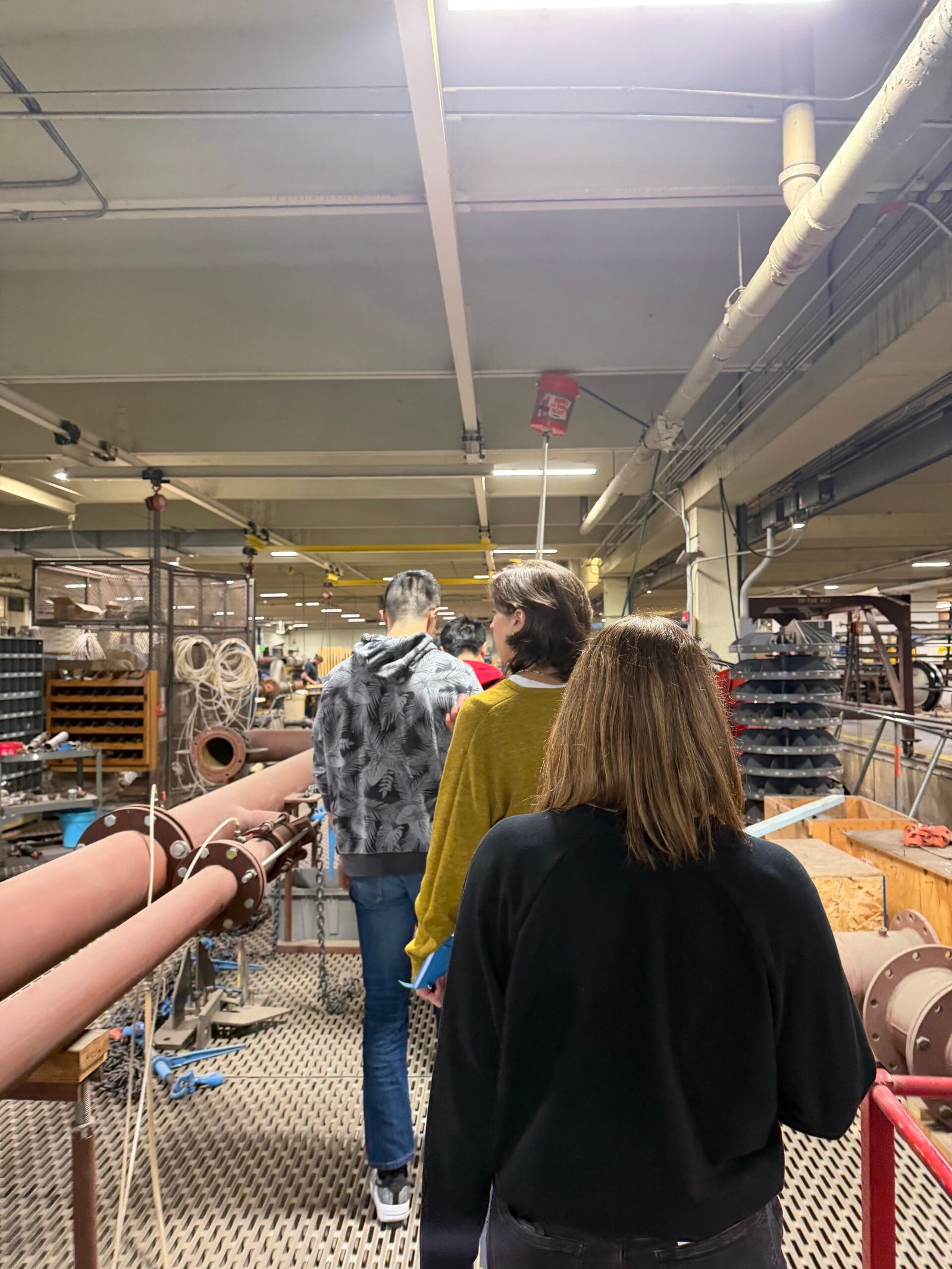
We also learned that water enters the facility from Logan Canyon’s First Dam and is used non-consumptively, passing through experiments rather than being used up.
Making Space for More Research
Next, we headed outside to another building where the laboratory is preparing for additional projects.
Beth shared that one of their challenges is having enough space for larger models. While scaling down infrastructure makes testing possible, larger models can more accurately reproduce certain real-world conditions.
It was interesting to learn that expanding research capabilities isn’t always about new technology. Sometimes, researchers simply need more room to conduct experiments at the scale necessary for reliable results.
From Hydraulics to Water Quality
Our next stop was the environmental laboratory, where we learned about research and testing involving PFAS, commonly known as “forever chemicals,” and harmful algal blooms.
Seeing this part of the facility highlighted the range of water-related challenges researchers are tackling. While the hydraulics laboratory focuses on how water moves, these laboratories help researchers understand what’s happening within the water itself.
For me, it was another reminder of how interconnected water quality, ecosystem health, and water management really are.
Connecting Research to the Great Salt Lake
One discussion that particularly stood out involved the Great Salt Lake and the complex movement of water between its north and south arms.
We talked about how salinity, density, and differences in water-surface elevation can influence water exchange between the two arms. It’s a fascinating example of how much there is still to understand about the lake’s behavior.
We also learned about the laboratory’s rainfall simulator, or “rainmaker,” and discussed possible applications for studying wildfire-affected landscapes and dust around the Great Salt Lake.
These conversations made me think about the opportunities to connect the laboratory’s tools and expertise with some of the challenges we’re working to address.
Strengthening Collaboration Across Utah
One of my favorite takeaways from the visit was learning about an initiative to bring together colleges and universities across Utah that are studying water.
The goal is to make it easier for researchers to share knowledge, collaborate across institutions, and connect their findings with others working on similar challenges.
I found this especially encouraging. Utah’s water challenges don’t exist in isolation, and neither should the research help us understand them. Creating stronger connections between institutions could help turn valuable research into more informed decisions.
Looking Ahead
What stayed with me most was how the laboratory makes complex water challenges tangible. Whether it’s watching water move through a scaled dam, learning about contaminants, or exploring opportunities for collaboration, each stop offered a new perspective on the importance of water research.
A big thank-you to Marian Rice for coordinating our visit and Beth Neilson for sharing her time, knowledge, and enthusiasm for the work happening at UWRL. We’re grateful to the Utah Water Research Laboratory team for welcoming us and giving us a behind-the-scenes look at their research.
I left with a greater appreciation for the work taking place at Utah State University and the opportunities to connect that research with efforts to protect and restore the Great Salt Lake.
After all, understanding our water is one of the first steps toward making better decisions about its future.
To learn more about the Utah Water Research Laboratory, explore its ongoing research, and see the work being done across Utah’s water systems, visit uwrl.usu.edu.